4k
Shares
.png)


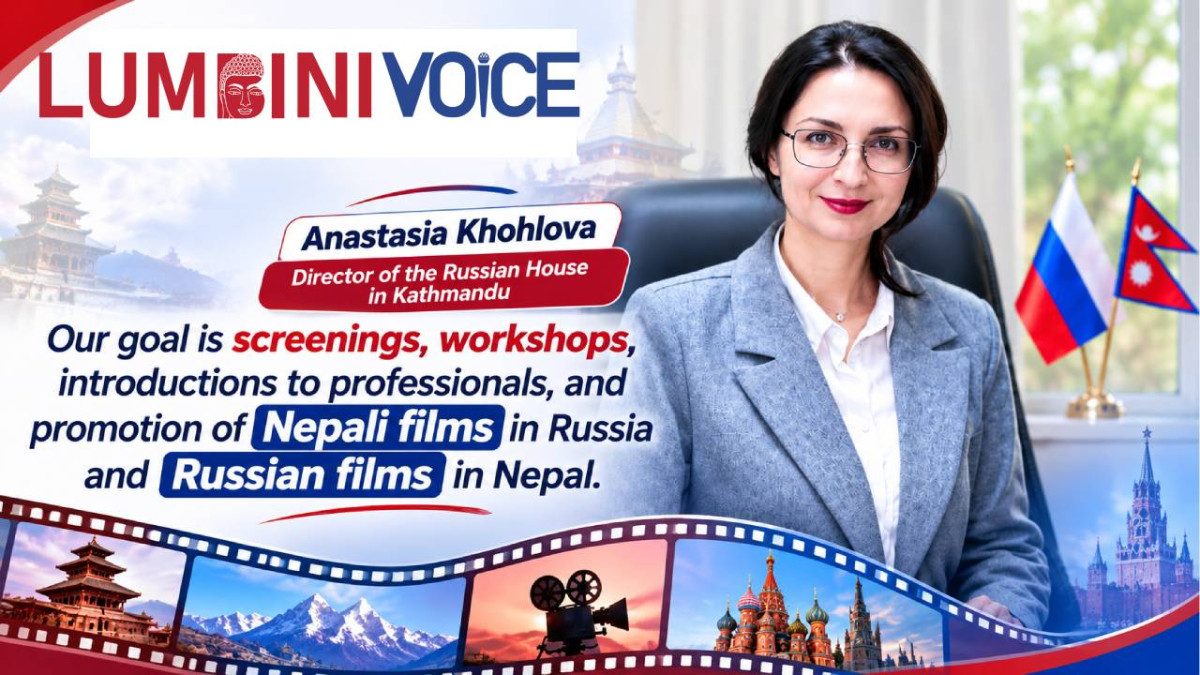
The second Kathmandu Horror Film Festival brings together 26 films from 21 countries, providing a platform for international filmmakers and promoting cultural exchange. With the support of the Russian House in Kathmandu, the festival also highlights the role of cinema in strengthening Nepal-Russia relations.
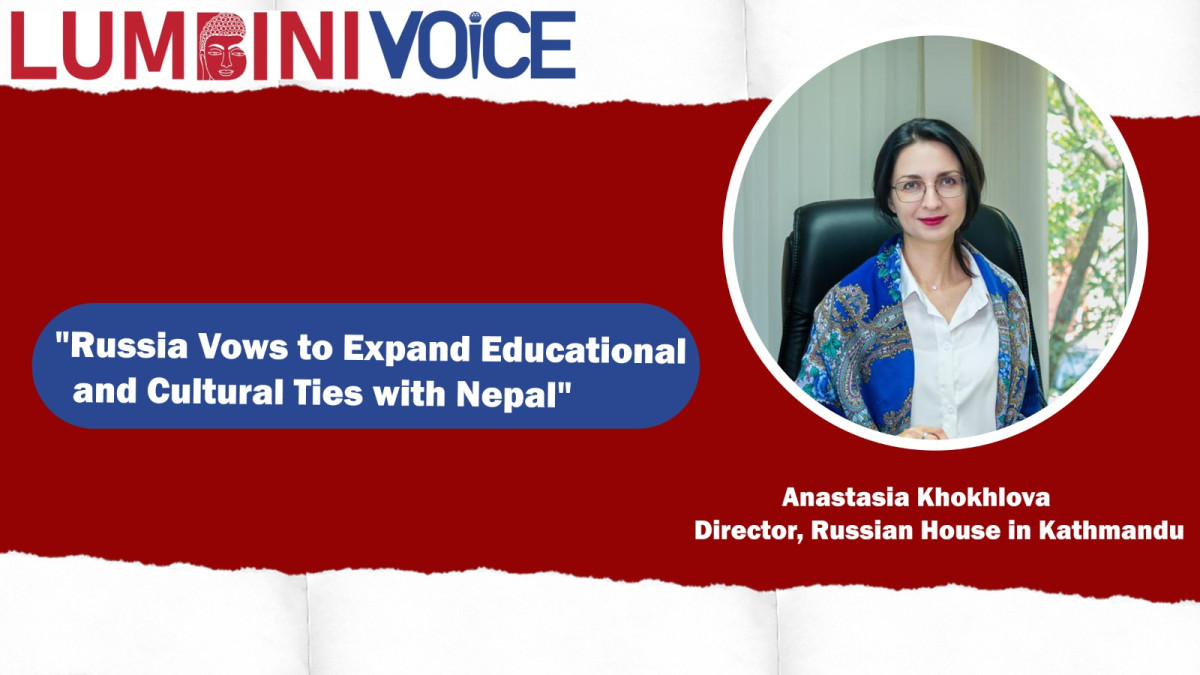
In this context, lumbinivoice.com Editor-in-Chief Tikaram Khadka conducted a written interview with Anastasia Khohlova, Director of the Russian House in Kathmandu. The interview explores horror cinema, opportunities for emerging Nepali filmmakers, Russian cinematic influence, and the role of cultural diplomacy in fostering creative collaboration and strengthening people-to-people connections. The following are edited excerpts.
1. The Kathmandu Horror Film Festival has entered its second edition, featuring 26 films from 21 countries. What is the aim of this festival, and how can it contribute to the development of Nepal's film industry?
KHFF was created as a platform where Nepali filmmakers can tell stories rooted in local legends, myths and traditions, while Nepali audiences discover genre cinema from around the world, including Russia. In its first year the festival screened 25 films from 15 countries. This year it has grown to 26 films from 21 countries across all continents. For a young Nepali director, that means seeing their work alongside films recognised at major international festivals, getting a live audience's reaction and building professional contactswith Russia and other countries. We do this together with the Nepal Film and Cultural Academy, with Mr. Rashik Pathak and his team, and I am sincerely grateful for their energy and dedication. I believe that projects like this gradually build both an audience culture and a professional community in Nepal.
2. Horror films are often perceived merely as a means of fear and entertainment. However, can the horror genre also be used to portray social, political, and psychological realities?
Absolutely. At its best, genre cinema has always been a way to speak about things that are difficult to say directly. A good example from this year's programme is In This Darkness I See You by Nadim Tabet: a ghost story that is really about the relationship between Lebanon and Syria and a past that refuses to let go. The themes of the festival are evolving from classic stories of fear toward films where horror grows out of social anxieties and the pain of the real world. Horror lets us test our limits and look our fears in the eye, which matters for society and for young creators alike.
The Russian non-competition feature film of the KHFF-2026 titled Wind is also much about social and psychological issues like crime and redemption, punishment and forgiveness, which has been one of the all-times topics of classical literature, for example by the world renown Russian writer Fyodor Dostoyevsky.
3. The Russian House has supported this festival for the second consecutive year. How significant is the role of cinema in strengthening cultural diplomacy and people-to-people ties between Nepal and Russia?
Cinema emerged at the turn of the 20th century and very quickly became more than entertainment. It combines image, music, word and story, and it is understood without interpreters because it speaks the language of emotion. That is why, already in the first half of the 20th century, states realised that a film can tell the world about a country better than any official document.
Today we call this "soft power": the ability to attract rather than persuade, to inspire interest and sympathy rather than apply pressure. A person who has watched a good film begins to wonder about the country behind it: its literature, music, language and people. When Mikhail Kalatozov's The Cranes Are Flying won the Palme d'Or at Cannes in 1958, it told the world how deeply Russian people feel and endure, and that said more about us than dozens of official speeches. Good cinema does not argue; it shares an experience, and that is why people trust it.
This matters greatly to us, because relations between countries are built not only between ministries but between people. When audiences from different countries sit in one hall, watch the same film and then argue about it, that is friendship between peoples in practice. After the screening of Wind, viewers stayed long afterwards, discussing the film and asking our producer questions. That kind of living dialogue is exactly what we hope for.
This is why the Russian House and the Nepal Film and Cultural Academy cooperate beyond KHFF. This year the Russian House became one of the official venues of the Nepal International Film Festival (NIFF), which will celebrate its jubilee in 2027, and we hope to continue this partnership. For us it is essential to remain a place that attracts Nepal's youth and film community, because cinema helps our two cultures not just to know about each other, but truly to understand each other.
4. Russian culture is both long-standing and distinct. What insights or lessons can Nepali filmmakers draw from the Russian film industry?
Russian cinema rests on a powerful literary and theatrical tradition and a strong school of screenwriting and directing. Wind, which we showed in Nepal for the first time, is based on a screenplay by Pyotr Lutsik and Aleksei Samoryadov. It is not a horror film but a philosophical drama with a touch of Tarkovsky, showing how a personal story can grow into a reflection on the fate of a country. I think the most valuable lesson for Nepali colleagues is not to copy a style but to look closely at one's own land, its margins and its people in times of change. Nepal has enormous material for this: folklore, mythology, living traditions. Exchanges, workshops and meetings with authors such as Wind's executive producer Alexander Ostroverkh-Kvanchiani help that dialogue.
5. Recently, a Nepali representative achieved remarkable success by reaching the finals of an international film-pitching competition held in Russia. What opportunities can the Russian House create to help young Nepali filmmakers access international platforms and develop collaborative projects?
We are very proud of the success of our Nepali colleague: out of dozens of foreign participants in the pitching competition "Cinema as a Tool Against Future Shock", only two reached the final, one from Nepal and one from Iran. We learned this from Roskino. We want to help him continue within the III International Symposium "Creating the Future" and hope to send him and his team to Russia to develop cooperation and share Nepal's unique national experience. We will keep working with Roskino and our Nepali partners, including the NIFF team, whose 2027 programme plans a pitching session for young directors in front of producers and distributors. Our goal is screenings, workshops, introductions to professionals, and promotion of Nepali films in Russia and Russian films in Nepal.
6. Beyond cinema, what other mediums does the Russian House emphasize to foster cultural exchange, social collaboration, and stronger bilateral relations, particularly those that highlight the participation and representation of young people?
Indeed, cinema is just one of many spheres of our activities. In 2025 the Russian House held more than 100 events: exhibitions, literary evenings devoted to Bhanubhakta, Mayakovsky, Lermontov and Devkota, and educational projects, including the "Higher Education in Russia" exhibition with more than 10 universities. We also held the "Real Rhythm & Soul" festival, where Nepali folklore and Russian ballet brought together 1,400 participants and raised funds for Cancer Care. We work with the Mitra Kunj association of graduates of Soviet and Russian universities and with our volunteers. With expert seminars and discussion programmes we promote science and technology with NRSTS. For us, young people are not just an audience but co-authors: volunteers, musicians, artists, students, researchers. They make the Russian House alive, and they are the ones who will make the future of the country a success.