5.3k
Shares
.png)


Nepal and Russia are entering the 70th year of formal diplomatic relations. From the time of the former Soviet Union to present-day Russia, Nepal’s relationship with Russia has seen various ups and downs, including in the areas of bilateral cooperation and exchanges. The Soviet Union’s contributions to Nepal- from education to infrastructure development- remain memorable for the Nepali people. In this context, how have the dimensions of Nepal-Russia relations changed in recent times? Has the time come to explore new dimensions of the Nepal-Russia relationship? On this subject, our representative talked with CPN (Maoist Centre) leader and Member of the House of Representatives, Madhav Sapkota. Here is an edited version of that conversation.
1. Nepal-Russia relations are going a long way from the situation of the Soviet Union. What could be the reasons for this?
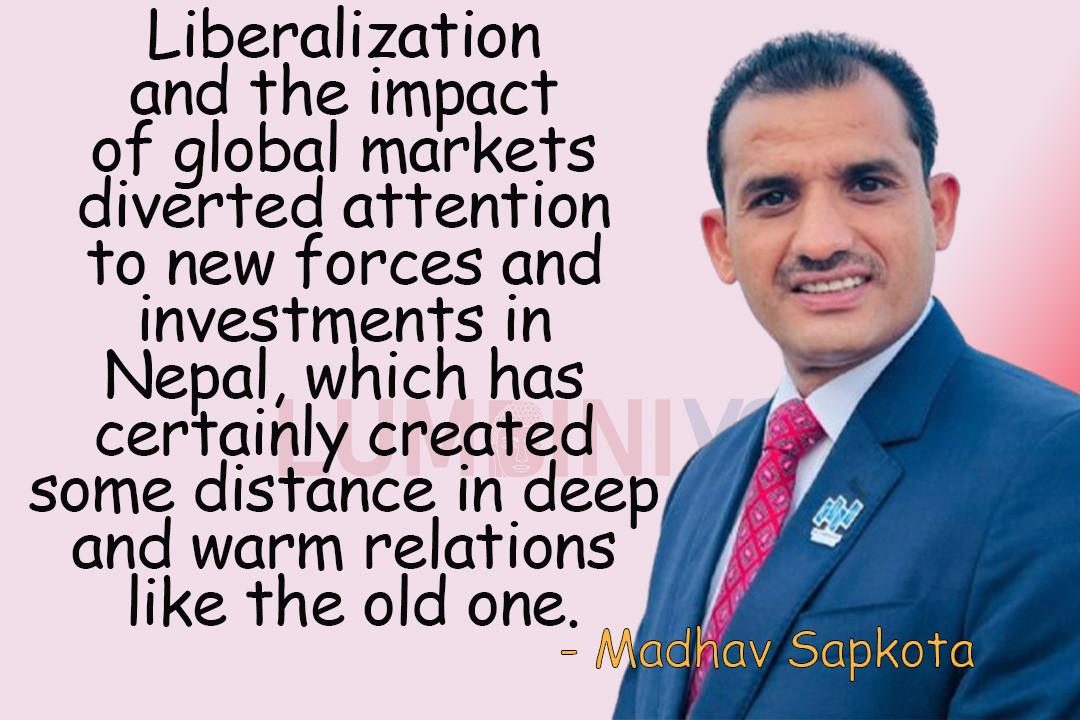
July 20 marks the 70th anniversary of the establishment of diplomatic relations between Nepal and the Soviet Union (Russia). Nepal and the Soviet Union established diplomatic relations on July 20, 1957, marking the beginning of cooperation in education, industry, and infrastructure development. When Nepal's literacy rate was around 10 percent, Russia started giving scholarships the same year. After the dissolution of the Soviet Union, Russia itself has long focused on facing internal political-economic crises. Nepal has also remained unstable due to political movements and changes of government. Both countries changed their priorities. Liberalization and the impact of global markets diverted attention to new forces and investments in Nepal, which has certainly created some distance in deep and warm relations like the old ones.
2. How do you think Nepal should take Russia's cooperation in Nepal, its contribution to development, and its dimensions, and what is right to focus on expanding relations in the coming days?
The Soviet Union has made a historic contribution to the construction of basic infrastructure in agriculture, industry, and transport sectors in Nepal. In particular, the Panauti Hydropower Project, built in 1965, was the soviet gift of the first megawatt capacity. Similarly, industries like Janakpur Cigarette Factory, Birgunj Sugar Factory, Birgunj Agricultural Tool Factory, Nepal Rosin and Turpentine Limited not only accelerated the industrialization of the country but also generated a huge amount of revenue and employment. Similarly, the 109-km-long east-west highway, the Dhalkebar-Pathlaiya section, was constructed by the Association. In 1963, the country's first children's hospital, Kanti Children's Hospital, was established with the initiative of Russia. Such large infrastructures played the role of the backbone of development. We should always remember all these contributions with respect. In the coming days, cooperation with Russia in hydropower, agriculture, industry, health, tourism, and technical education should be further strengthened. At the same time, we have a clear view that it is necessary to increase cooperation and investment through transparent G2G agreements and bring programs targeted at the new generation.
3. There have been some gaps in Nepal-Russia exchange of high-level visits and other issues. What do you think is the reason behind this?
- After the dissolution of the Soviet Union, Russia took a long time to survive in the new order. Inflation, recession, internal and external conflicts weakened both its economy and diplomacy. In the transition to systemic change, it was natural for external relationships to be thin.
In the meantime, there was a people's war led by the Maoists in Nepal, which focused the government's attention on internal political and security challenges. Frequent changes in government, lack of a clear foreign policy, and shifting of government priorities to other countries or partners also did not bring the desired activism in relations with Russia.
It seems that high-level visits, technical exchanges, and project implementation have decreased due to their respective internal problems and international circumstances of both countries.
4. After Nepali youths involved in the war in Russia enlisted in the army, Nepal took a stand on various issues upon their return. However, should Nepal's relations with Russia and its multi-dimensionality be linked to the issue of enlisting in the army?
- This incident is a separate incident due to personal and employment, it should not be directly linked to the diplomatic relations between the two countries. But from a humanitarian point of view, it is natural for Nepal to express concern for its safety and take initiative to bring its citizens back home.
5. It has been alleged that not only Nepalis but also other countries are participating in the Russia-Ukraine war. In such a situation, some Nepalis are saying that they are fighting a war in favor of Lenin's nation. What are the things that Nepal needs to do to properly manage and organize such issues?
- The government and foreign agencies should adopt a clear policy on such sensitive issues. Nepali youth should be given safe alternative opportunities in foreign employment, education, and business. Nepali missions abroad should be made more active. Independently, the desire of some is different from the issue of political consciousness; here, it is necessary to take action on the whole issue, not the individual.
6. Former Chairman of the National Assembly Ganesh Prasad Timilsina's statement that Russia wants necessary initiatives to expand relations with Nepal does not seem to have been heard anywhere. What is the reason for this situation?
- There may be a variety of reasons. The Russian side has also argued that no formal request has been received from the Government of Nepal, as the Russian Embassy had sent a letter to Nepal seeking detailed proposals for 13 different projects after the visit of former chairman Ganesh Prasad Timilsina to Russia. Political instability, Lack of a long-term strategic approach, and administrative delays have led to such proposals becoming inactive. At times, there may be pressure or a lack of attention, but the hearing may not be heard. The government should adopt clear and active diplomacy to improve this.
7. There is an acute shortage of chemical fertilizers in Nepal. Russia has already offered fertilizers through G2G. But it is said that the government is shying away from compromising on such proposals to facilitate farmers. What is your opinion on this?
- There is an acute shortage of fertilizers in the country, and farmers are suffering. I have also raised this issue in Parliament many times. G2G is considered well in the contract, after this contract, quality fertilizer comes on time. Therefore, we believe that it is appropriate to take Russia's proposal seriously and implement it quickly.
8. Finally, what is the right way to take Nepal-Russia relations to a modern and new dimension? What are your suggestions?
- Increasing education and technical scholarship targeting the new generation is our need. At the same time, cooperation in hydropower, agro-industry, health, and infrastructure sectors should be further strengthened. Russian tourists can be increased by encouraging tourism, especially in the Himalayan region. High-level visits and cultural exchanges should be made regularly and effectively. Government-to-government cooperation, investment summits, and trade expansion should be given priority, as well as cooperation in areas of common challenges such as climate change.
Most importantly, Nepal should formulate a long-term strategy with a non-aligned foreign policy and national interest at the centre. Only in this way. Nepal-Russia relations can be made modern, sustainable, and multi-dimensional to deal with the challenges of modern times.