7.4k
Shares
.png)


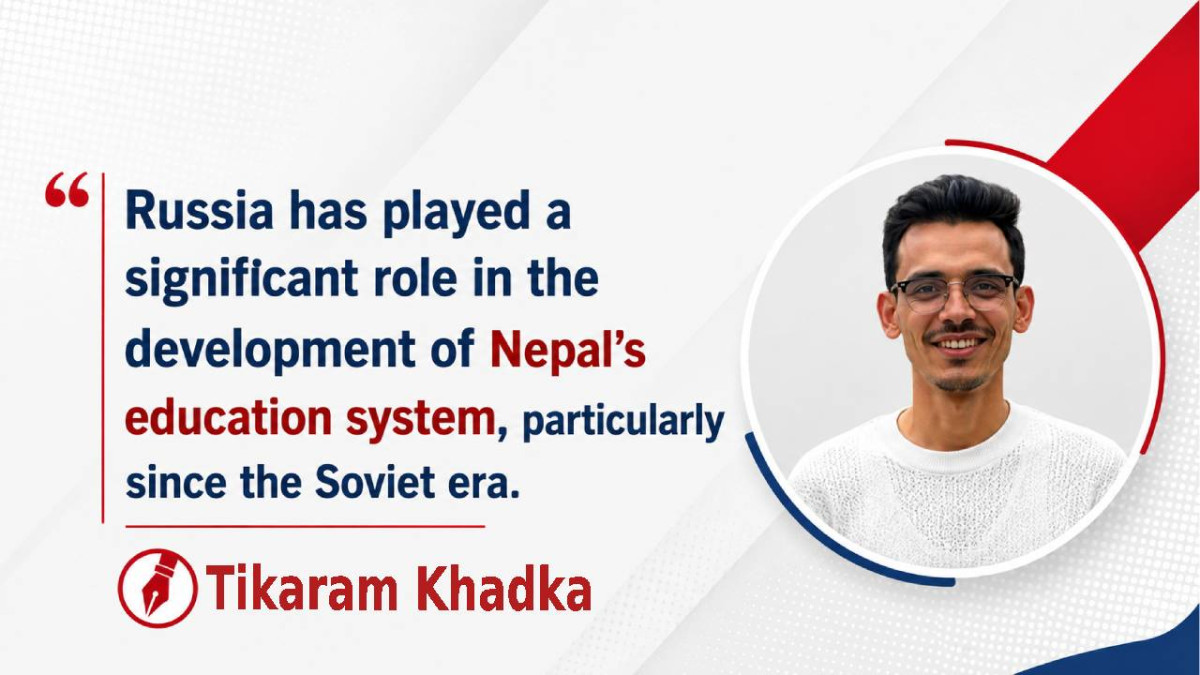
Nepal-Russia relations have various dimensions. It has been 70 years since diplomatic relations were established between the two countries. Russia, which was once Nepal’s largest development partner, has made an extraordinary contribution to Nepal’s education system.
Foreign affairs expert, Hiranyalal Shrestha writes in 'Mitratako Sayapatri', ‘In places such as Buryatia, Tuva, Aginskoye, Chita, Irkutsk in the eastern part of Russia, and in Kalmykia, which lies in the European part, Buddhists are in the majority. It is said that in the seventh century, a Buddha statue from Nepal reached Buryatia via Tibet, where it was kept after a monastery was built, and the Buddhist mantra 'Om Mani Padme Hum,' written in the Ranjana script, is still customarily written there. It is mentioned that in 1741, Empress Elizabeth Petrovna granted Buddhism official state recognition within Russia. In 1875, the Orientalist Minayev came to Nepal, collected Buddhist scriptures and took them back, and after studying Nepal, returned and even published a book. In 1903, Europe’s first Buddhist monastery was established in St. Petersburg. Shrestha further writes, During the Second World War, Russian and Gurkha soldiers fought bravely against the Nazi fascists as part of an alliance. These things also clarify many aspects of our friendship and relationship.
Nepali students not only got the opportunity to study in Russia on scholarships, but they also had the chance to shape the main outline of their future.
Meanwhile, Nepal has made remarkable progress over the past few decades in expanding access to education. Today, most children in the country attend school, the female literacy rate has increased, and student participation in higher education has also expanded. However, quality education, investment in research, rural-urban disparities, and the production of skilled human resources remain challenges. The number of Nepali students going abroad for higher education and research continues to rise, leaving no doubt that there is still a need for more high-quality educational opportunities within the country.
The education system of the Russian Federation, on the other hand, is based on a long scientific tradition. Russian universities have earned global prestige in mathematics, physics, space science, medicine, and engineering. Since the Soviet era, research and innovation have been national priorities, and their impact can still be seen today. Modern laboratories, a strong research culture, and scientific thinking have made Russian higher education internationally competitive.
Educational relations between Nepal and Russia also go back decades. During the Soviet Union era, Nepali students had the opportunity to study medicine, engineering, and other technical subjects through scholarships. Many of them returned to Nepal and made significant contributions in the fields of health, education, infrastructure, and public services. Even today, Russian universities continue to attract international students, including those from Nepal.
Whether it is Upendra Mahato, Bhagwan Koirala, or other distinguished figures who studied in Russia, they have made a global impact on Nepal’s reputation.
The scholarships provided by Russia and its advanced treatment methods have saved the lives of many Nepalis. They have even gone to foreign lands and saved many lives there. This also further illustrates how Russia’s investment in education has strengthened the dimensions of the relationship between the two countries.
Toward the end of June 1989, Dr. Bhagwan Koirala had the opportunity to speak on a stage alongside students from various countries during his graduation program. On page 38 of his book 'Hriday', he wrote: “I felt that I had a very good opportunity to learn the fundamentals of medical science and technology. It was there that I learned cultural and human values and interpersonal communication skills, which have remained an important guiding aspect of my life to this day.” Koirala is the fist doctor who start open heart surgery in Nepal. Although, he established the foundation of Shahid Gangalal Hospital. He worked in this field for a long time at Tribhuvan University Teaching Hospital. Not only that, he also participated in the treatment of the wife of former King Gyanendra Shah following the incident that wiped out King Birendra’s lineage. She is still alive today. This also demonstrates the strength of the Russian education system.
Education is not limited to textbooks; it also provides an opportunity to understand culture, language, and society. Many Nepalis who studied in Russia say they were influenced by the country’s discipline, commitment to research, and scientific mindset. Likewise, foreign students and researchers who come to Nepal regard the country’s cultural diversity, Himalayan civilization, and community-based way of life as important subjects of study. This kind of exchange gives the citizens of both countries the opportunity to understand each other better.
In the digital age, the nature of education is changing rapidly. Artificial intelligence, online learning, open educational resources, and international research collaboration are leading universities around the world in new directions. For Nepal, this transformation is also an opportunity. Educational cooperation with Russia can be further expanded through student exchanges, joint research, faculty exchanges, and science- and technology-focused projects.
Nepal can learn a great deal from Russia in areas such as investment in research, strengthening technical and vocational education, university-industry collaboration, and the development of science education. Likewise, Nepal can also share with the international community its experience in expanding education in remote geographical areas, managing education in a multilingual society, and promoting inclusive education through community schools.
In today’s world, education is not an issue confined within the borders of a single country. International cooperation is essential to address global challenges such as climate change, health, technology, and sustainable development. In such a context, educational relations between Nepal and the Russian Federation can contribute not only by providing opportunities for students but also by fostering shared knowledge creation, research, and world peace.
In an interview with me about Russia’s education system and the benefits Nepali students are receiving, Anastasia, the director of the Russian House, said, 'Now citizens of Nepal are also equally eligible to apply for Russian state scholarships to get the opportunity of free of charge studies under bachelors’, masters’ and post graduate programs at Russian state universities. All the selected applicants get the extra first year of the Russian language course at Russian universities with tuition free of charge. Now the quota allocated for Nepal comprises 40 scholarships annually, but due to the high demand we have traditionally been getting extra quota during the last years, allowing over 60 Nepalese per year to get higher education in Russia.' This also clearly demonstrates the relationship and integration between Nepal’s education system and the Russian education system.